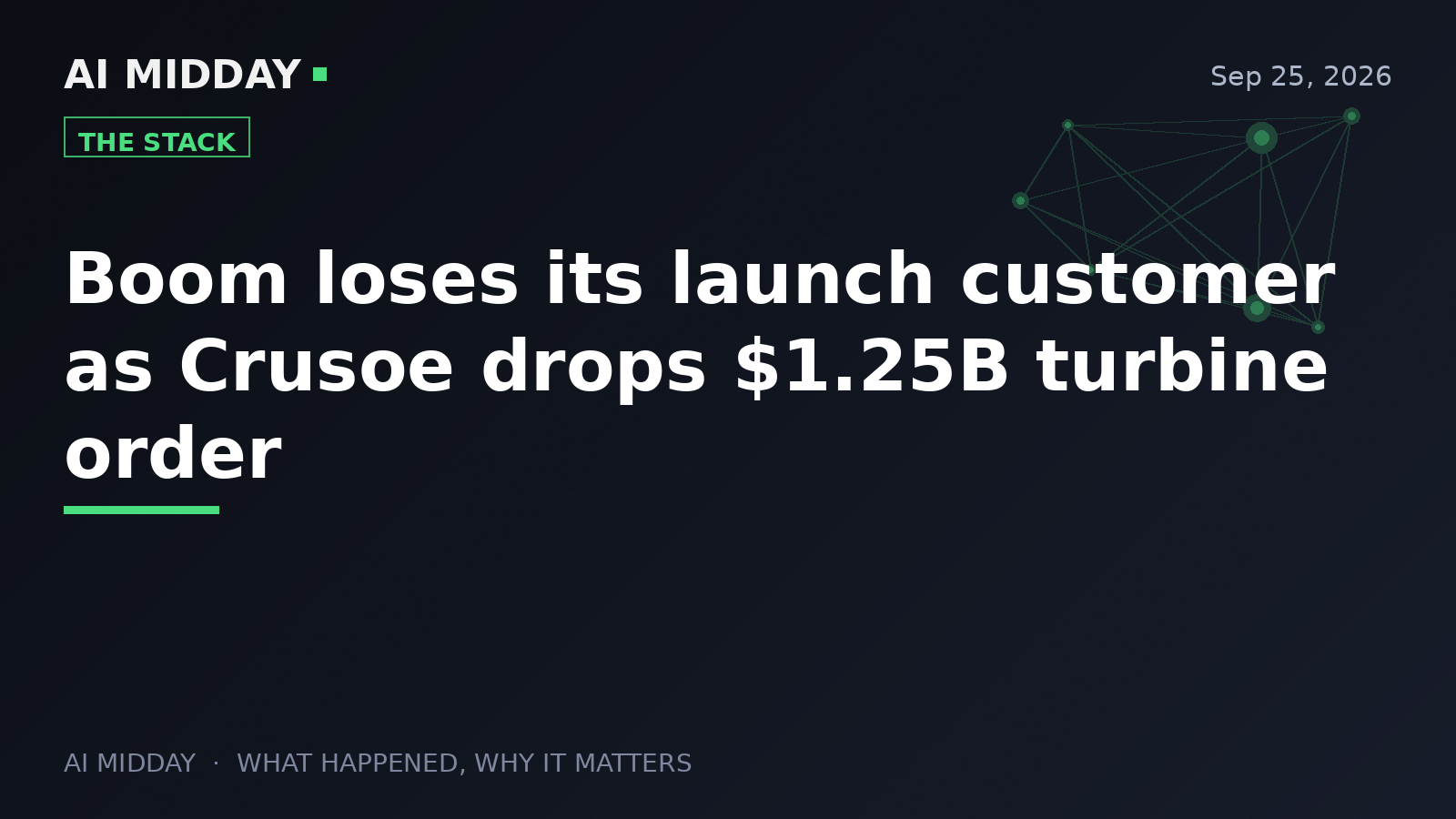
Boom loses its launch customer as Crusoe drops $1.25B turbine order

AI's power buildout just got its first visible cancellation, and a 4B model out of the open-source world showed how cheap an agent's decision layer can be.
Crusoe has walked away from a $1.25 billion order for Boom Supersonic's Superpower turbines, ending the launch partnership the two Denver companies announced last December. Boom chief executive Blake Scholl broke the news Friday evening on X, writing that "turbines are no longer part of Crusoe's near term primary power mix at Abilene/etc., so a launch partnership just didn't make sense." Crusoe confirmed to TechCrunch that it is no longer doing business with Boom. The order covered 29 Superpower units at 42 megawatts each, about 1.2 gigawatts of gas-fired generation for AI campuses, with first deliveries due to begin in 2027.
The timing is what makes it interesting. Crusoe raised $3.9 billion last week and says it now chooses energy per site "as its needs evolve" — including wind, solar, batteries and the grid. Boom keeps its story intact for now: Scholl says about 250 megawatts of Superpowers ship to other sites next year, with 1 gigawatt targeted for 2028, and the $300 million round that funded the business was raised around Crusoe's signature. So this reads less like a broken company and more like an AI infrastructure buyer discovering it can be choosier about power than it was last winter. AI data centers are still on track to out-burn Germany and Japan on gas by 2035 — the demand didn't go anywhere, the procurement just got pickier.
A 4B model trained for under $30 of rented GPU time can now run an agent's yes/no gates without generating a single token. Mica v0.1, released under Apache-2.0, takes a state, a question and the allowed answers, then returns a calibrated probability for each: yes/no, a choice among up to 255 options, or a score on 2 to 10 levels. It reads the prompt once and reads the probabilities of its answer labels, so a decision costs one prefill — 54 milliseconds at BF16 on an RTX 3090, 47 ms at Q4. The pitch is cost: Jev, the hosted model TypeSafe sells for exactly this job, still leads on accuracy (74.7% versus 67.4% on Mica's 7,328-item held-out set), but it bills per call while Mica runs on an 8 GB GPU and accepts the same request format, so clients written for Jev work unchanged.
The author's demo is the honest part: 23 decisions took a Mineflayer bot from an empty inventory to an iron pickaxe on a live Minecraft 1.4 server, with zero output tokens ever generated. LocalLLaMA greeted it with a Rule Four self-promotion warning — that's how you know a model release didn't come from a lab with a comms team.
A small model that scores options instead of writing prose also fits neatly with the scale-at-the-edge pattern Microsoft has been pushing with Project Zenith: the cheap work goes local, and the expensive reasoning gets called only when the gate says yes.
What to watch: whether Boom's remaining 2027 slots convert into firm orders — the 250 megawatts Scholl promised next year is the number that decides whether this was a cancellation or a repricing.
Would you run your agent's guardrails on a local 4B classifier instead of asking a frontier model to answer yes or no? Tell us in the comments.
Sources: TechCrunch · Blake Scholl (X) · Boom Supersonic · Mica v0.1 4B (Hugging Face) · Mica (GitHub) · JevBench (GitHub)