Deep Dive — Alibaba's 2.4T open model is a strategy, not a gift

On Wednesday morning Beijing time, Alibaba's Qwen team posted the weights of its most powerful model to Hugging Face on the exact schedule it had signaled two weeks earlier. The download is 4.45 terabytes spread across 213 files — and with it, for the first time, a Max-class frontier model is something people can run rather than rent. It is simultaneously the open camp's biggest win of 2026 and the clearest sign yet that "open" no longer means what it used to.
The story looks simple from the headline: Alibaba open-sourced a 2.4-trillion-parameter model whose marketing pitch is "performance comparable to Anthropic's Fable 5." The release itself is anything but simple. Three things about it deserve the long treatment: what the model actually is, the hardware it takes to run it, and the license — a custom contract that quietly redraws the line between open weights and open business. We covered the drop the day it landed in Qwen open-sources Qwen3.8-2.4T-A95B, its first Max-class model; this is the part of the story that brief couldn't hold.
What actually shipped
The model card reads like a flagship's: 2.4 trillion total parameters with 95 billion active per token, a mixture-of-experts design spanning 512 experts of which 10 are routed plus one shared, 92 layers, and a hybrid architecture that interleaves gated linear attention (a DeltaNet-style recurrent component) with the expert layers — the same family of design that has quietly become China's house style for frontier models. It carries a native 262K-token context window that extends past a million, was trained with multi-token prediction, and ships with reasoning_effort controls that trade depth for cost.
Two constraints shape what builders actually get. The open weights are text-only, and thinking mode is mandatory: every response begins with a reasoning block wrapped in think tags, and the toggle is off the table. The version with vision input, non-thinking mode, a default 1-million-token window and built-in tools is the API model, Qwen3.8-Max on Qwen Cloud — priced, per early reporting, at $2 per million input tokens and $6 per million output tokens, squarely at the aggressive end of the market (xAI set the same numbers for Grok 4.6 days earlier). Alibaba's launch material also boasted of the model coding autonomously for 16 days in testing — a long-horizon claim that tells you where the company wants this benchmarked: agentic endurance, not trivia.

Where it actually ranks
The Chinese coverage sold the release as "性能比肩Fable 5" — performance on par with Fable 5. Alibaba's own table tells a more interesting story. Qwen3.8-Max leads the field on PaperBench at 93.0, ahead of GPT-5.6 Sol's 90.5 and Fable 5's 88.8, and tops the table on instruction-following (82.8) and professional-work evals. But on SWE-bench Pro it scores 67.7 against Fable 5's 80.0 — a 12-point gap on the benchmark that best predicts real software-engineering value — and on Humanity's Last Exam it lands at 43.6 versus Fable 5's 53.3. FrontierSWE tells the same story: 73.5 against 88.8. This is a model that leads on agentic and research-oriented tasks and trails the frontier precisely where closed labs still lead.
There is a second caveat, and it matters more. Every number in that table is vendor-reported and cross-harness: the Qwen series was evaluated on the OpenCode harness while the Claude models ran on Claude Code and Sol ran on Codex, each with different timeouts and judging setups. The model card's own footnote concedes the results come "from our own testing." Until independent runs land on identical harnesses — Artificial Analysis or a serious community benchmark — the honest label for "comparable to Fable 5" is a claim, not a measurement. That caveat is not pedantry; it is the same gap that let DeepSeek's headline numbers carry the open camp's last big release.
The download is the easy part
Four-point-four-five terabytes. That is the BF16-class weight set: 213 shards of 32 GB each, ungated, one command away on Hugging Face or ModelScope. Storage is the easy part. Running the model means holding most of those weights in accelerator memory, and a single H100-class GPU holds about 80 GB — so the realistic floor is a multi-node cluster measured in dozens of GPUs, the kind of machine that Nvidia's GB300 NVL72 rack exists to be. Nvidia published a day-zero serving guide for exactly this model on that platform, with early reports clocking it at more than 4,000 tokens per second — throughput that only makes sense on a 72-GPU rack. vLLM, SGLang and TokenSpeed all support it from day one, and quantization will shrink the footprint the way it did for DeepSeek's V4 Pro — but a 4-bit 2.4-trillion-parameter model still lands in the terabytes.
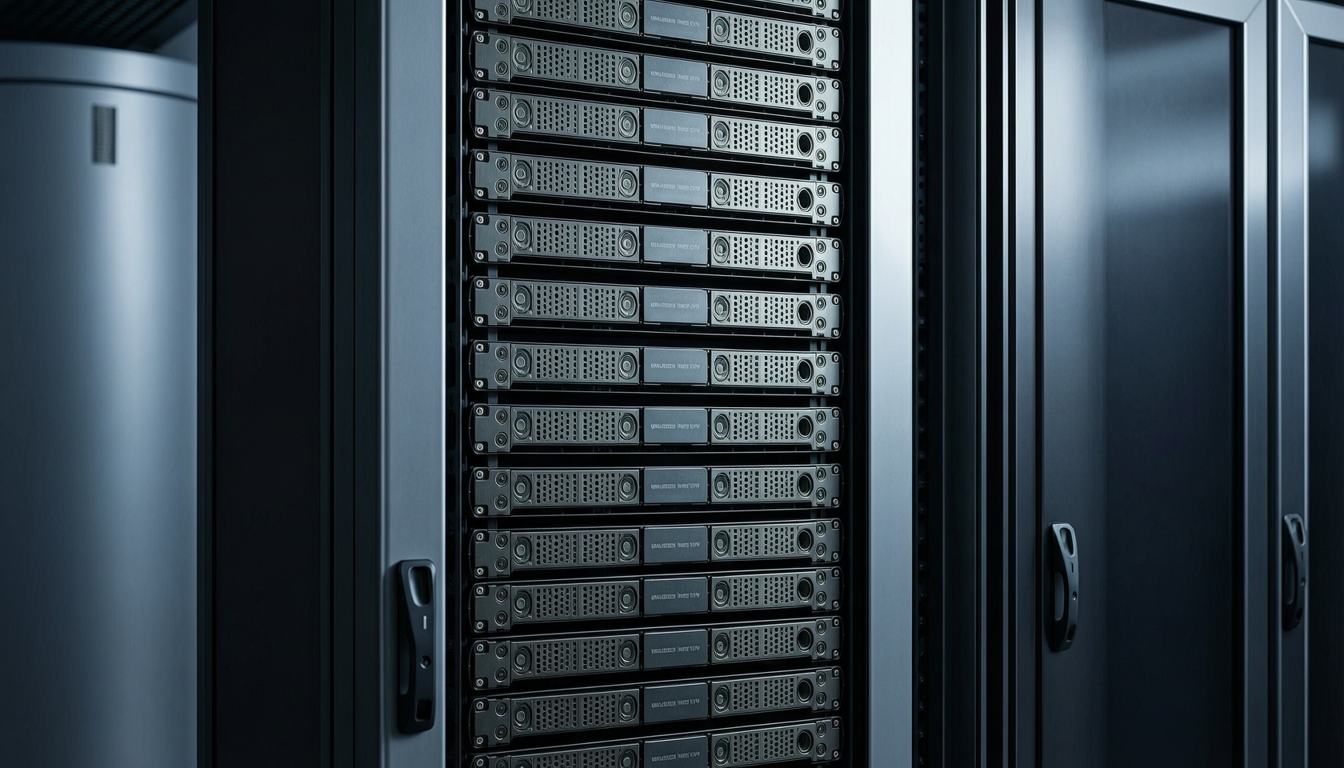
The honest summary: "anyone can download" is true; "anyone can run" is a data-center sport. That is precisely why the promised sibling matters. Qwen3.8-27B, the dense model meant for ordinary machines, is reportedly arriving August 15 — and reading the r/LocalLLaMA threads on the release, it is the model the community is actually waiting for. The 2.4T drop was the flag planted; the 27B is the one people can use.
The license is the real headline
Here is where the release stops looking like a gift. The weights ship under a custom "Qwen3.8-Max License," not the permissive Apache-style terms of earlier Qwen generations — and not MIT like the DeepSeek V4 Pro weights that landed the same week, as we covered in DeepSeek's V4 Pro open weights finally land on Hugging Face. The contract has two thresholds. Above 100 million monthly active users or $20 million in monthly revenue, a product using the model must display the Qwen name prominently. And any business running a model-as-a-service or an AI coding/office assistant whose aggregate revenue passes $50 million in any 12-month period must obtain a separate commercial license from Alibaba before using the weights for commercial purposes — internal use is exempt, but serving the model to third parties at scale is not.
Read the fine print and you see the strategy: this is the "revenue-sharing" that Reuters reported in early August, when sources said Alibaba planned to charge large commercial users of its next open model, with the split still under discussion. The license made the mechanism concrete — not a percentage, but a gate. Startups are free; any company that builds a competing API or assistant business on Qwen's shoulders and reaches real scale must come to the negotiating table. Forkast, which analyzed the license the day after the drop, called it "a platform play, not a gift," and noted the market read it the same way: Alibaba shares rose about 7 percent in Hong Kong and 4.5 percent on the NYSE. None of this makes the release less valuable to developers — but it makes it something other than open source in the OSI sense, which requires the training data and code, neither of which is public. As we explained in What are open-weight models?, the weights being downloadable is the beginning of the openness conversation, not the end of it.
Why Alibaba did it
The release only makes sense inside the moment China's model economy flipped from free to paid. In the space of two weeks: DeepSeek flagged API price increases running as high as 470 percent on some tiers, 01.AI began winding down its open developer platform, the Qwen app introduced paid memberships, and Alibaba opened its Qwen platform to third-party agents. The two-year price war is over, and the labs that survived are the ones that can monetize. Qwen's open-weights strategy is the loss leader that feeds the rest of the machine: the weights generate adoption and benchmark credibility, and the money is made in the Qwen Cloud API, the app, and the distribution deals — Apple's China Apple Intelligence runs on Qwen (with Apple now also training its own China model with Alibaba's support, as we covered this morning), and Honor's robot phone is built on Qwen's foundation models. Even the talent market is reading the same tea leaves: the ex-Qwen chief who left to found an agent startup reportedly raised at a $2 billion valuation, because the value has moved to the application layer.
The two-pronged release is the tell. Ship the 27B to capture the developer base and the local-inference crowd; ship the Max weights as the flagship that proves frontier capability — and gate the commercial upside behind the $50 million line. Alibaba wants to be the default model provider of the open ecosystem the way it wants to be the default cloud: everyone is welcome, as long as the plumbing runs through Hangzhou.
What it means for the frontier fight
The strategic stakes for the closed labs are straightforward: every frontier open-weights drop ratchets the pricing pressure on their APIs. Anthropic's Fable 5 — the model Qwen is being measured against — sold just 6 percent of Anthropic's tokens in its first month at $10 per million input and $50 per million output. AT&T says open-weight models already power about a quarter of its 45 billion daily AI tokens and expects 70 to 80 percent over time. The gap between "frontier" and "open" is now measured in months, not years, and Alibaba just demonstrated that the gap's most capable member is free to download.
There is also a second-order effect the release accelerates: distillation. Open weights are the cheapest possible training fuel, and the fight over it is already hot — a Tübingen-led study published this week found the hidden reasoning of Kimi K3 strikingly similar to Claude's and GPT's, the strongest public evidence yet in the distillation fight, and Moonshot's Kimi K3 already drew US security scrutiny after its own open-weights release in July. A 2.4-trillion-parameter model with a $50 million commercial gate still allows anyone to train a distilled derivative for internal use — the gate taxes competing businesses, not copying. And Washington is reportedly "almost certain" to extend its AI oversight framework to frontier open models, a framework that is nearly unenforceable the moment weights are public. The Qwen release is the test case that framework will be built against.
The contrarian case
The skeptical reading writes itself, and it is mostly right. The benchmarks are self-reported, cross-harness, and selectively favorable. The weights come without data, training code, or a recipe — you can run Qwen3.8, fine-tune it, and study it, but you cannot rebuild it, which means self-hosting still leaves you dependent on Alibaba for the next version and, at scale, for permission. The people with the hardware to run 2.4 trillion parameters are largely the people who could already afford frontier APIs. And "comparable to Fable 5" survives contact with the actual table only if you ignore SWE-bench Pro and HLE, where the gap is a canyon.
The counter-case matters too. The same dismissals were written about DeepSeek a year ago, and DeepSeek's MIT-licensed V4 Pro — 1.6 trillion parameters, 890 GB, no gates at all — is the standing proof that the permissive path still works as strategy. Quantized and community-tuned derivatives of this model will be running on real workloads within weeks, not years, and the open camp's actual prize was never running 2.4 trillion parameters at home. It is that frontier-scale weights are now something any research group, any regulated enterprise, any government auditor can inspect, fine-tune, and benchmark directly — the one thing closed APIs can never offer, and the one thing the license cannot take back. Alibaba can tax the business built on the weights. It cannot uninvent them.
What to watch
Five things. First, Qwen3.8-27B, reportedly arriving August 15 — the release that will actually determine how much of this story reaches normal hardware. Second, independent benchmarks: watch what Artificial Analysis and community harnesses report on SWE-bench Pro and HLE under identical conditions. Third, the license's commercial terms for large users — the split ratio and the price Alibaba names when a $50-million-revenue company knocks. Fourth, whether closed labs answer on price; Fable 5's slow start at $10/$50 just got a lot harder to defend. Fifth, Washington: if the oversight framework extends to frontier open weights, this release is the precedent everyone will cite.
If the most capable open model in the world comes with a $50 million revenue gate, is it open — or a demo with a toll booth? Tell us in the comments.
Sources: Qwen3.8-2.4T-A95B on Hugging Face · Qwen3.8-Max announcement · Forkast — Qwen 3.8 license analysis · Cryptobriefing — Qwen3.8 on Nvidia GB300 · TMTPost — Alibaba's revenue-share plan for Qwen · r/LocalLLaMA discussion