Deep Dive — Unitree's 629% debut and the hunt for China's next robot champion

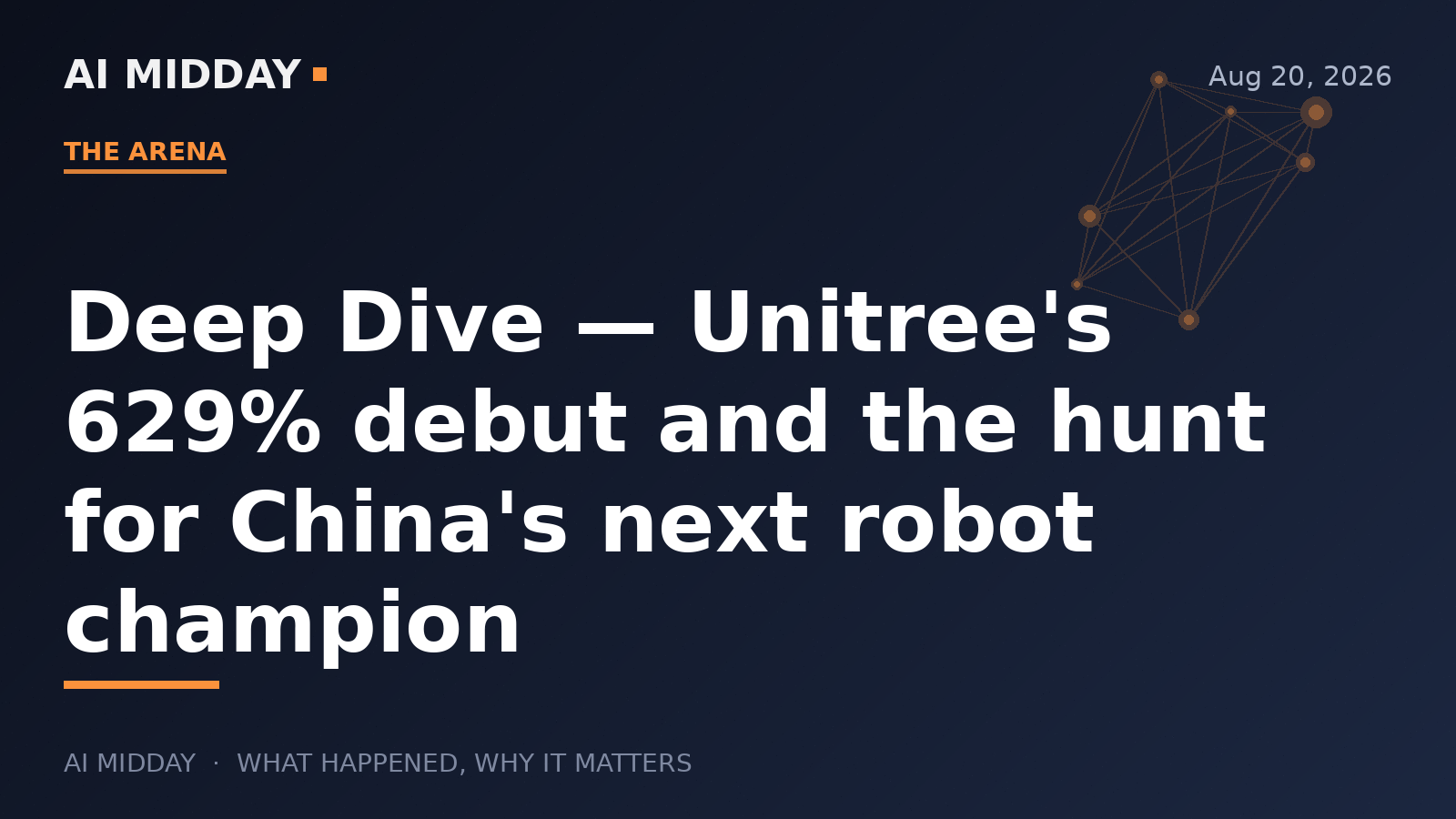
On August 19, Unitree Robotics became the first humanoid-robot maker to list on mainland China's stock market — and the market treated it less like an industrial-equipment debut than like a lottery. Shares opened 629.44% above the IPO price and closed the day up 460.34%, pushing the company's market value above 340 billion yuan, roughly $47 billion. The pop happened on the same morning the 2026 World Robot Conference opened its doors in Beijing, turning one company's first trading day into a verdict on an entire industry.
We covered the subscription frenzy and the $9 billion pricing in the run-up — Unitree IPO oversubscribed 5,000+ times in record retail frenzy and Unitree prices $9B humanoid IPO, first in mainland China — but the debut itself is the story's payoff, and it reframes the question everyone in the sector is now asking: who comes next?
What a 629% open actually means
Unitree priced its shares at 150.8 yuan ($22.40) and raised about $900 million, valuing the company at roughly $9 billion on paper. The first trade valued it closer to $50 billion. That is not a rational single-day re-rating of a hardware company's cash flows; it is a market voting on a thesis — that embodied AI is the next great export category and that the winner of China's humanoid race will be worth more than most legacy manufacturers combined.
The comparison investors keep reaching for is instructive. At its post-debut value, Unitree is worth more than many established industrial and automotive names that ship real, profitable volume today. The gap between that price and the company's fundamentals is exactly where the debate lives. First-quarter adjusted profit fell more than 52% year on year on R&D and marketing spend, and nearly three-quarters of its humanoid revenue still comes from research and education buyers rather than factories or homes. The stock is pricing in a future where robots earn their keep at scale; the balance sheet is still paying to get there.
The show is no longer about the demo
The reason the pop felt like a sector referendum is that the 2026 World Robot Conference was designed to look like a procurement event, not a science fair. More than 300 companies exhibited, up 36% from last year, and the show added a first-ever "Procurement Day" — a signal that the industry is being judged on scene landing and commercial delivery, not on choreographed dancing. The calculus the market now applies has shifted: spectacle no longer moves valuations, deployed units and signed contracts do.
That is the real news underneath the percentage. For two years the humanoid story was a parade of videos. Now the buyers are in the room, and the companies drawing capital are the ones with a path from prototype to paying customer. Unitree's edge was never that it built the most beautiful robot — it was that it built the cheapest one that worked well enough to ship, and it shipped a lot of them (5,500-plus units in 2025, by one earlier count). The market is betting that boring, repeatable delivery beats a viral clip.
The contenders: who is actually "next"
The WRC floor doubled as a preview of the IPO pipeline. Five names kept coming up as the most likely to follow Unitree onto public markets, and each represents a different bet on what the winning robot company looks like.
Deep Robotics (云深处科技) is the quadruped incumbent, holding more than 85% share in power-inspection and fire-emergency scenarios with 1,200-plus deployed sites. Its "one person, one cat, one dog" lineup spans quadrupeds, wheeled-leg hybrids, and the DR02 industrial humanoid, which has already passed live substation testing. Crucially, it filed for a STAR Market listing in May and is already profitable — 2025 revenue of 337 million yuan (about $47 million) on a three-year compound growth rate above 150%. In a field of cash-burning startups, "already makes money" is a serious differentiator.
LimX Dynamics (逐际动力) is the high-heat private contender. Its full-size humanoids — the interaction-focused LimX Luna and the task-capable Oli, running an in-house "humanoid brain" system called COSA — anchor a $200 million pre-IPO round closed in July at a 15 billion yuan ($2.1 billion) valuation, after raising $400 million across the prior six months. It is one filing away from joining the public queue.
Realman (睿尔曼智能) is the infrastructure play. Rather than selling finished robots, it builds the joints, lightweight arms, and a remote "teleoperations" network that lets a human operator drive a machine through real work anywhere on earth — refilling pharmacy shelves, inspecting electrical rooms, even assembling mooncakes on a production line. It has filed for IPO tutoring and was profitable in 2025. Its pitch is that the robot is a platform, and the money is in the whole stack.
Star Era (星海图) is the "model plus body" unicorn, born from an autonomous-driving lineage. It runs vision-language-action models and a "world action model" it calls Fast-WAM, and showed robots doing bagging, sorting, and transport in unseen scenarios without extra tuning. A 2 billion yuan ($280 million) B+ round in April pushed cumulative funding near 5 billion yuan ($700 million) and its valuation past 20 billion yuan ($2.8 billion).
Zhiyuan Robot (自变量机器人) is the world-model bet, with a "world unified model" architecture and an open-source embodied model, WALL-OSS-0.5, that deploys zero-shot on real hardware. It closed four rounds in roughly two months at a valuation above 20 billion yuan, backed by Meituan, Alibaba, ByteDance, and Xiaomi alongside Sequoia and IDG, and has reportedly filed confidentially for a Hong Kong listing. Notably, in the first half of 2026 Zhiyuan outsold Unitree in unit terms — the "next Unitree" may already be ahead on volume.
The skeptic's case is getting louder, not softer
The bull case is obvious; the bear case is the more useful read. Asset managers who spoke to CNBC before the listing called today's humanoids "a large-sized toy," noting they run only a few hours before recharging and must be retrained for each new task. Analysts point out most models still can't do unsupervised housework, and that the revenue base is propped up by labs and universities buying for research, not by the factories and homes the valuations assume.
The macro math cuts both ways. Wood Mackenzie projects a global humanoid fleet above 10 million units by 2035, with prices down 93% since 2020 to about $58,000 — Unitree's $16,000 G1 reportedly costs just $82 a year to power. But the same analysis warns that 10 million robots could strain power grids already stretched by AI data centers. And the geopolitical ceiling is hard: a US import ban on foreign humanoids and quadrupeds landed days before the offering, capping Unitree's 13% US revenue even as Beijing's 10,000-unit domestic deployment push props up demand at home. Tesla, meanwhile, is converting Fremont EV lines to build Optimus, running the same thesis from the other side of the Pacific.
There is also a quieter provenance question. Reporting this month noted that Unitree's Go-series quadrupeds drew on openly published US university research that was itself funded by the US military — a reminder that "domestic" robotics supply chains are more entangled than the flag-waving suggests, and that export controls cut both ways.
What to watch next
The debut is the opening bell, not the closing price. Three things will tell us whether the 629% open was a beginning or a peak.
First, the follow-on listings. Zhiyuan's reported Hong Kong filing, Leju's Shenzhen plans, and Deep Robotics' STAR Market acceptance mean Unitree's pop sets the pricing reference for an entire pipeline of robot IPOs. If the next one lands well, the sector gets a durable valuation floor; if it stumbles, Unitree's number becomes the high-water mark everyone compares against.
Second, the delivery data. The thesis lives or dies on units that do paid work unsupervised. Watch for evidence that humanoid revenue is shifting from research-and-education buyers toward industrial and service deployments, and for the first credible "robot pays for itself" case studies out of the new procurement programs.
Third, the grid and the ban. Beijing's 10,000-unit push is a demand floor, but the power-grid constraint is real, and the US import ban is a hard ceiling on overseas growth. A domestic-only robot champion is a smaller company than a global one — and the market is currently pricing a global one.
Unitree's first day priced in a future where Chinese robots run the world's factories, homes, and grids. Is that a forecast or a fever — and which of the five contenders do you think actually gets there first? Tell us in the comments.
Sources: 量子位 QbitAI · 雷峰网 Leiphone · Bloomberg via Techmeme · CNBC · Reuters